The aloo
Why does Kolkata biryani have a potato?
The short answer: the potato came to Calcutta with Nawab Wajid Ali Shah, the last ruler of Awadh, exiled here in 1856 with his Lucknowi cooks. Why they put it in is genuinely disputed. The story everyone tells is that meat had become too expensive. The historical record does not really support that.
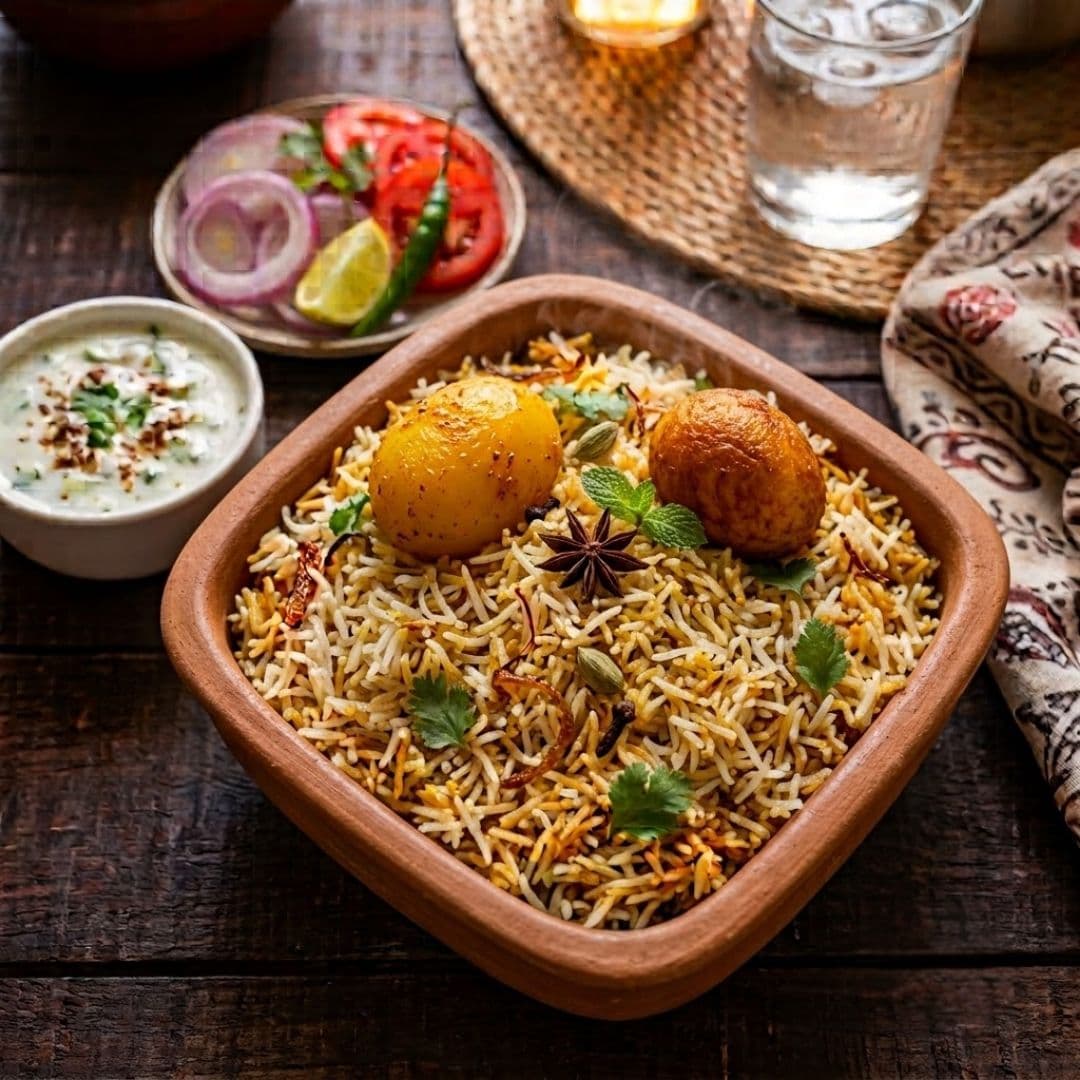
The aloo and the egg, the two things that tell you a biryani is from this city.
The story everyone tells
In 1856 the British East India Company removed Wajid Ali Shah, the tenth and last Nawab of Awadh, from his throne in Lucknow. He was moved to Metiabruz, then on the southern edge of Calcutta, and he brought his court with him: musicians, dancers, kite makers, and crucially his kitchen.
What those cooks made was Awadhi biryani, sealed in a handi and finished slowly over low heat. Lighter than the Deccan style, more perfumed than fiery. That is the biryani this city inherited.
And the story goes that the Nawab, now a deposed ruler living on a British pension, could no longer afford the mutton his kitchen was used to buying. So the cooks stretched it. Less meat, more rice, and potatoes to fill the gap. A poor man's substitute that a city then fell in love with.
It is a good story. Most people in Kolkata grew up with some version of it.
The problem with that story
The Nawab does not appear to have been poor. Contemporary accounts of his years in Metiabruz describe a household running on a considerable scale, including a private menagerie stocked with tigers and leopards. By some accounts he was spending in the region of 9,000 rupees a month simply on feeding the animals.
Whatever else that is, it is not the household of a man whose cooks were padding out the biryani because mutton had become unaffordable. If you can feed tigers, you can buy goat.
So the economics at the heart of the popular story do not really hold up.
A more likely explanation
There is a second account, and it inverts the first entirely. In nineteenth-century India the potato was not a cheap staple. It had arrived relatively recently, cultivation was limited, and it was expensive and unfamiliar enough to be treated as something of a delicacy.
On that reading, the potato was not what you added when you ran out of money. It was what you added to show off. An exotic import, cooked in saffron, going into a dish already built to impress. This version has been put forward by Manzilat Fatima, the Nawab's great-great-granddaughter, who cooks and writes about the family's food.
It fits the man better. Wajid Ali Shah was a poet, a patron and a notorious aesthete. A kitchen serving him was far more likely to be chasing novelty than cutting corners.
What we can actually say
Honestly, nobody can prove either version. There is no kitchen note from Metiabruz explaining the decision, and both explanations are reconstructions made long after the fact.
What is not in dispute is the outcome. A biryani travelled from Lucknow to Calcutta in 1856, changed here, and became something the city now treats as its own. The potato is the clearest marker of that change. Order a biryani anywhere in Kolkata and if the aloo is missing, you will hear about it.
We think the luxury explanation is the more convincing one. But the more useful point is that the potato was never filler, whichever story you prefer. It is cooked in the handi with everything else, it takes on the stock and the spice, and for a lot of people it is the best thing in the bowl.
Related questions
While we are here
Where this comes from
We are a kitchen, not a history department, so it is worth saying where we read this. If you want to go deeper, these are good starting points.
Ours comes with the aloo. Obviously.
Dum-cooked to order in Krishnapur and delivered across Salt Lake Sector V and New Town.